How air conditioner consumption is calculated
An air conditioner's consumption varies over time and depends mainly on the amount of cooling (or heating) the room requires and on the efficiency with which the system produces it. The two key variables are therefore the home's thermal demand and the device's energy efficiency.
In residential settings and on European energy labels, the annual consumption estimate is normally based on the SEER for cooling and the SCOP for heating, indicators that represent the air conditioner's seasonal efficiency. These values make it possible to convert the cooling or heating capacity into electricity consumed on an annual basis.
What are SEER and SCOP?
- SEER (Seasonal Energy Efficiency Ratio)
- Seasonal average efficiency indicator for cooling that measures the ratio between cooling produced and electricity consumption over an entire cooling season
- SCOP (Seasonal Coefficient of Performance)
- Seasonal average efficiency indicator for heating that measures the ratio between heat produced and electricity consumption over an entire heating season
From here on we focus on cooling mode, but the formulas are identical for heating: simply swap the SEER with the SCOP. To estimate consumption, you take the cooling capacity and divide it by the SEER, obtaining the average electrical power drawn: the higher the SEER, the less electricity is needed for the same cooling.
Cooling power represents the air conditioner's ability to remove heat from the room per unit of time. It is a measure of the system's thermal size, not of electricity consumption. This quantity is often expressed in BTU/h.
What is a BTU?
- BTU/h (British Thermal Unit per hour)
- A unit of thermal power that indicates the amount of heat the air conditioner is able to remove from or add to the room per unit of time (typically one hour). 1 BTU/h equals about 0.293 W, so 12,000 BTU/h corresponds to roughly 3.5 kW of cooling or heating
Multiplying this electrical power by the running time gives the energy consumed, and from that the cost:
It is important to note that the result is an estimate of consumption under typical operating conditions, not a precise measurement. Actual consumption can vary depending on compressor behaviour, the outdoor temperature, the home's insulation level and the set temperature.
How to reduce air conditioner costs
The cost of running an air conditioner depends directly on the electricity it consumes, so reducing the bill doesn't come down to a single factor but to optimising the system's three main variables: the unit's efficiency, how intensively it is used, and the room's thermal load.
The first thing to act on is the air conditioner's energy efficiency. For the same cooling power, a model with a higher SEER/SCOP consumes less electricity to deliver the same level of comfort. The difference between energy classes can translate into significant variations in the annual bill, especially with prolonged use during the summer months.
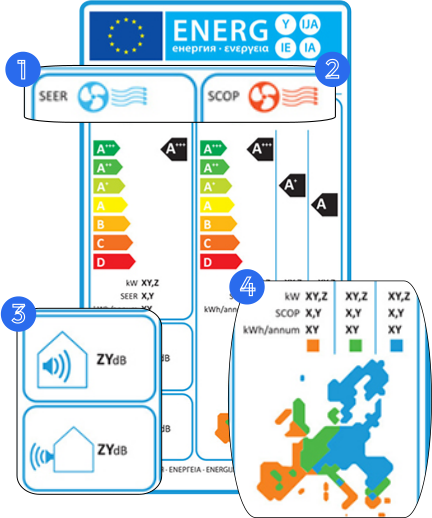
- 1Measures the seasonal cooling efficiency
- 2Measures the seasonal heating efficiency
- 3Indicates the noise levels in decibels of the indoor and outdoor units
- 4Map of Europe divided into three zones (warm, average, cold) and the respective heating consumption
A second decisive factor is managing the home's thermal load. Improving insulation, reducing direct sun exposure and limiting warm-air infiltration reduces the amount of cooling the system needs. The set temperature also has a direct impact on consumption: every degree lower increases the work required of the compressor and therefore the electricity used.
A third aspect concerns how the unit is used, which significantly affects the final cost. Running continuous programmes at a stable temperature is generally more efficient than frequent on/off cycles. In inverter systems, keeping a constant temperature lets the compressor work in a modulated regime, reducing consumption peaks.
One last element that is often underestimated is the price of electricity, which directly affects the final cost regardless of the air conditioner's efficiency. For the same kWh consumption, even relatively small changes in the energy price can translate into significant differences on the annual bill. For this reason, beyond optimising the unit and its use, it is essential to review your electricity offer and compare it with more competitive alternatives.
Find out how much you can save on energy
Upload your billFrequently asked questions
How much does an air conditioner consume per hour?
Hourly consumption depends on the model's power and efficiency, but on average a domestic 9,000-12,000 BTU air conditioner in a good energy class draws about 0.4-0.7 kW. That corresponds to roughly 0.4-0.7 kWh for each hour of operation. At an energy price of 0.30 €/kWh, the hourly cost is indicatively between 12 and 21 cents.
How much does it cost to run the air conditioner all day?
A 12,000 BTU unit in class A++ running continuously can consume on the order of 10-14 kWh per day, depending on ambient conditions and the temperature setting. That is equivalent to about 3-4 € per day at an average energy price of 0.30 €/kWh. The actual value varies with the climate, the home's insulation and the model's efficiency.
Is it better to switch off the air conditioner or leave it on?
In general, for short absences it is more efficient to keep the air conditioner on at a slightly higher temperature, avoiding the consumption peaks needed to bring the room back to temperature. For long absences it is better to switch it off. Inverter systems further reduce the difference, modulating power to maintain the temperature with more stable consumption.
How many BTU do I need for my room?
The size of the air conditioner depends on the floor area and the room's thermal load. As an average estimate, you need about 340-380 BTU per square metre. A 20 m² room generally needs about 9,000 BTU, while rooms between 30 and 35 m² typically need 12,000-18,000 BTU. Factors such as sun exposure, the number of windows and ceiling height can significantly increase the requirement.
How much does the energy class affect consumption?
The impact is significant. For the same cooling capacity, a high-efficiency air conditioner can consume up to 30-40% less than a less efficient model. Over a multi-year horizon, this difference has a substantial effect on the total cost of use and often offsets the higher initial price.
How can I reduce the air conditioner's bill?
Reducing costs depends on three main levers: choosing an efficient model, reducing the home's thermal demand and optimising usage habits. Another often decisive factor is the price of energy: comparing electricity offers and selecting a cheaper tariff directly reduces the cost of every kWh consumed, regardless of the type of air conditioner used.